Friday, January 12, 2007

Donuts on a Rope

An update to the "Exotic Propulsion Aircraft" page on the Federation of American Scientists web site that was recently brought to my attention provides a new photograph of a "donuts on a rope" contrail, shot on November 10, 2006. These contrails are interpreted by many people as evidence of secret, high-speed aircraft utilizing Pulse Detonation Wave Engines (PDWE). The "donuts" in the contrails are thought to correspond to the individual detonations that propel the craft.

Donuts on a rope contrail. ©2006 Chris W. Johnson
Donuts on a rope contrail closeup. ©2006 Chris W. Johnson
Donuts on a rope contrail. ©2006 Chris W. Johnson
Donuts on a rope contrail closeup. ©2006 Chris W. Johnson
Origin of contrail. ©2006 Chris W. Johnson

I would dearly love to believe that the origin of these contrails is a secret aircraft, because I'm fascinated by such things, because I've been waiting to see such a contrail ever since I first read about them in the May 11, 1992, issue of Aviation Week & Space Technology magazine ("New Evidence Bolsters Reports of Secret, High-Speed Aircraft", page 62), and, most particularly, because I observed and photographed two "donuts on a rope" contrails on June 26, 2006.

The photos shown here are of the second contrail, which was the more clearly defined of the two. They were shot from windows on the 25th floor of The University of Texas at Austin Tower using a Canon Digital Rebel camera set at ISO 200 and equipped with a Canon EF 100-400mm f4.5-5.6 image-stabilized lens. The contrails proceeded from east to west. These photos were taken between 8:01 and 8:03 PM CDT.

The final photo, taken at 8:03 PM, shows the origin of the contrail as it neared the western horizon. In order to maximize contrast, the photo's dynamic range has been expanded to its useful limits, a yellow filter applied, and it has been converted from color to monochrome. Unfortunately, there isn't enough detail to identify the aircraft. However, given the specificity of the time and place, FAA flight logs should make an identification possible. (If someone does make that identification, I hope they'll leave a comment with the details.)

For myself, I do not believe PDWE-powered aircraft were responsible for either of the contrails I observed. First, it seems unlikely to me that a secret aircraft would be flown over a large city in broad daylight, especially twice in one afternoon. Second, I heard no remarkable sounds before, or during, my observation of these contrails. Third, and most significantly, the photograph of the origin of the contrail shows that the contrail begins as two separate trails, each one presumably from the jet engines on either side of a commercial airliner. I can only speculate that atmospheric conditions, combined with the air turbulence produced by the aircraft, conspired to merge the two trails into one, and to disturb it at regular intervals, perhaps as a wake vortex periodically intersected the trail.

Of course, I'd much prefer to believe that I'd recorded evidence of a secret aircraft, due to my long-standing fascination with such things (and what photographer wouldn't like to have taken an "important" photograph?), but I believe the evidence points to a prosaic origin in these two cases, and ultimately leaves me in doubt as to the significance of any of the "donuts on a rope" observations.

Disappointing, but interesting, nonetheless.

Wednesday, January 3, 2007

Blue Origin Revealed

Jeff Bezos' team at Blue Origin has been extremely secretive about the rocket they've been developing (until now), but it was pretty clear that it was going to be a vertical take-off, vertical landing (VTVL) vehicle, and probably a lot like the Delta Clipper Experimental (DC-X) vehicle that BMDO and NASA flew years back. Well, Blue Origin has finally shown the world what they've been working on, and, yes, the Delta Clipper concept is reborn, and flying, right here in Texas.

Magnificent!

(If you folks ever need panoramic, or stereo, photos of your setup, just say the word. :-)

Memory Lane

Here's a video of the first flight of DC-X on August 18th, 1993, and a photograph, courtesy of Susan Karasoff, from the DC-X rollout on April 3, 1993.

Delta Clipper Experimental (DC-X) rollout, April 3, 1993. ©1993 Susan Karasoff.

Thursday, December 14, 2006

Geminids and Mysteries

I watched the peak of the Geminids meteor shower last-night/this-morning from the Bamberger Ranch, with the kind permission of the Bambergers. (They even threw in a slice of Margaret's birthday cake. Happy birthday, Margaret.) I setup a pair of the original Canon Digital Rebels, one with a Sigma 20mm, f1.8 lens, and the other with a Sigma 10-20mm, f4-5.6 lens set for 10mm and f4. Both were shooting RAW, manual-focused on infinity, set for ISO 400, and using a shutter speed of 30 seconds. They were aimed such that the field of view of the 20mm lens was entirely subsumed in the field of the view of the 10-20mm lens, set at 10mm. I shot about 270 frames with each camera, concurrently, but with the shutters staggered to try to avoid missing meteors while one or the other camera had its shutter closed.

From past experience, I knew the 20mm, f1.8 lens could capture some meteors. I had doubts that the 10-20mm would be of any use at f4. My first look at the results credits the 20mm, f1.8 lens with 8 meteors, and the 10-20mm at f4 with 4 meteors, even though it covered four times as much sky as the 20mm lens. So, the 10-20mm, f4-5.6 lens isn't completely useless for meteor showers, but it's a very poor choice for such work. Not much of a surprise there, but now I know.

A Geminid meteor falling over the Bamberger Ranch. ©2006 Chris W. Johnson.

The good news is that all of that driving, and those four hours of shivering and photography produced my best meteor photograph so far (taken with the 20mm, f1.8 lens, of course). That meteor wasn't the most spectacular of the 198 I counted, but it was a good one. The best of them all was really two meteors that entered at the zenith at the same moment, but going in precisely opposite directions. One burned-out quickly, but the other had a good, long run, and burned so bright against the black of the sky that it reminded me of seeing a thin ribbon of magnesium burn in a high school chemistry class.

One peculiar happening while I lay out there on the cold ground controlling the cameras and counting occasional meteors, was a sound off in the dark distance that I can only say made me imagine an angry hawk, expressing its anger in high-pitched wheezes. This sound came several times, then the usual quiet returned. It's quiet out there in a way that city dwellers, like me, may have a hard time grasping. There are no man-made sounds to be heard. Not even a distant hum of traffic on some highway. There's just the wind blowing through trees, and a few crickets. It takes a while to notice it, but it stands out in a big way once you do. So, the wheezing came from nowhere and then vanished into that amazing quiet. A minute or two later, the wheezing returns from the same direction, but closer. Soon, hooves are heard running on the hard ground, coming from that direction towards me. They seem to account for at least four animals, but what sort of animal, I can't figure. My untrained ears claim that the hoof-falls are too heavy to be deer, but too light to be cattle. The sound of the hooves seems to be ahead of the wheezing, which chases after them. The sounds come closer and closer and I begin to wonder if some panicked livestock are about to show-up and trample my cameras. Their eyesight and hearing are almost certainly better than mine, so they should know I'm ahead, but they keep coming anyway. Just ahead of that wheezing. I let out a quick whistle to try to ensure that they're factoring me into their plans. It doesn't seem to have any effect on their pace or course, but soon the hoof-falls stop, seemingly for their own reasons. Whatever was making them is nearby; I can hear them breathing hard, but can't see a thing. Their breathing dies away, and the quiet is beginning to settle in again when the wheezing returns, and then hooves are running again, but now parallel to me, and then away and out into the invisible grass, and the remarkable quiet.

Monday, December 11, 2006

Qwicap 1.4a42 Released

Qwicap 1.4a42 has been released. (Download it from SourceForge.) This version has been in the works for almost six months, off and on. It was bedeviled by two problems: (1) a thread synchronization bug that could manifest when a user submitted new form data before the processing of their previous hit was complete, and (2) a misunderstanding between myself, a colleague who administers some of our servers, some obscure error reports from the JVM, and some Google searches, that led us to conclude (incorrectly) that Qwicap absolutely had to have a thread pool in order to operate reliably over long periods of time.

With regard to the thread synchronization bug: Ouch. I could not reproduce it when running the server and the web browser on the same box (my normal method of working), even when the box was a multi-processor machine. If a colleague, Kevin Wood, hadn't noticed this bug and then invested serious effort in exploring it, I don't know when it would have been found. Just to keep it interesting, the fixes to Qwicap 1.4a37 that he provided to me didn't work in his test setup when I supplied him with builds from the official codebase that incorporated all of his changes. (Those builds worked fine on my machine, naturally.) The builds he produced from the older codebase worked fine in his test setup, and mine. Even after we both sat down and satisfied ourselves that I hadn't mangled, or omitted, any of his modifications, the problem persisted in my builds, when he ran the tests on his box. In the end, he set up a box for me that was configured essentially the same as his machine, and I did my own testing. Eventually, I identified one last race condition that even he'd missed. (I throw no stones here; if I hadn't missed it in the first place, he couldn't have missed it in the second.)

With regard to the perceived need for a thread pool, I put a lot of work into building, instrumenting and testing a thread pool based on the mistaken belief that our production servers were encountering a memory-related resource exhaustion problem related to the total number of threads created over the lifetime of any given Qwicap application. In the end, it turned-out that the problem was confined to the amount of memory consumed by the stacks of the threads running at any given time, when running under Java 1.5, which dramatically increased the default stack size relative to Java 1.4 (it seems to have gone from 256K to a megabyte or more). Initially, configuring our servers to run Tomcat in a 64-bit address space solved the problem, and later configuring them to use only 256K as the default stack size provided an alternate solution.

So, Qwicap doesn't turn-out, strictly speaking, to need a thread pool to operate reliably, but I implemented one before that became clear to us, and therefore it now has a thread pool. There's no point in ripping it out, because (a) some people will actually want it, (b) a lot of nice status data gathering machinery became tied to it, (c) it can be configured such that it doesn't hang onto any threads, if you wish, and therefore won't get in the way of people who don't want pooling, and (d) the configuration parameters for the pool allow the size of the Qwicap thread stacks to be controlled, which goes to the heart of the real problem.

Other noteworthy changes in Qwicap 1.4a42 include:

  • The concept of "blocking listeners" has been added. Such listeners, registered using the new Qwicap.addBlockingListener method, are invoked just before and after Qwicap blocks to wait for user activity. This applies to the prompt methods, and the redirect method, and will apply to any future blocking methods. Thus a "blocking listener" can perform actions like releasing and reacquiring limited resources like database connections, or log application activity, transparently from the perspective of a web application's code.
  • There is now a "service data recorder" (SDR), for lack of a better term, built into Qwicap. The SDR accumulates data in hourly chunks (up to 72 of them). Each hour's data includes information on the thread pool (total size, number of active and inactive threads, number of threads created and allowed to die, number of threads unavailable due to the max. pool size limit), user sessions (number completed and expired, and the mininum, average and maximum duration), hits (total number, hits directed to invalid pages, and the minimum, average and maximum response time), and RAM usage (amounts free, used, and total). For the time being, the SDR reports are available only in a human-readable format, because I am hesitant to commit to what data will be gathered, how it will be represented, etc.

At this point, my main goal for Qwicap is to finalize the 1.4 release. I'm prepared to declare it feature-complete now. (Therefore, I should have released it as a "beta", rather than an "alpha".) While it doesn't include all of the features I'd originally intended it to have, it's the most significant revision to Qwicap thus far, and at some point you just have to draw a line across such an effort, declare it complete, and add the missing features to the list for the next major revision. Furthermore, the current release version, 1.3.3, is almost a year old at this point, and lacks a number of bug fixes and important improvements that are present in 1.4. (Backporting the fixes and improvements to common code became an unsupportable burden some time ago, with the never-quite-ready-for-release version 1.3.4.) The thought of people putting-up with 1.3-isms when they should be benefitting from 1.4-isms is really getting on my nerves. So, expect the 1.4 release in the not-too-distant future, bug reports permitting.

Thursday, November 23, 2006

The Real Thing(s)

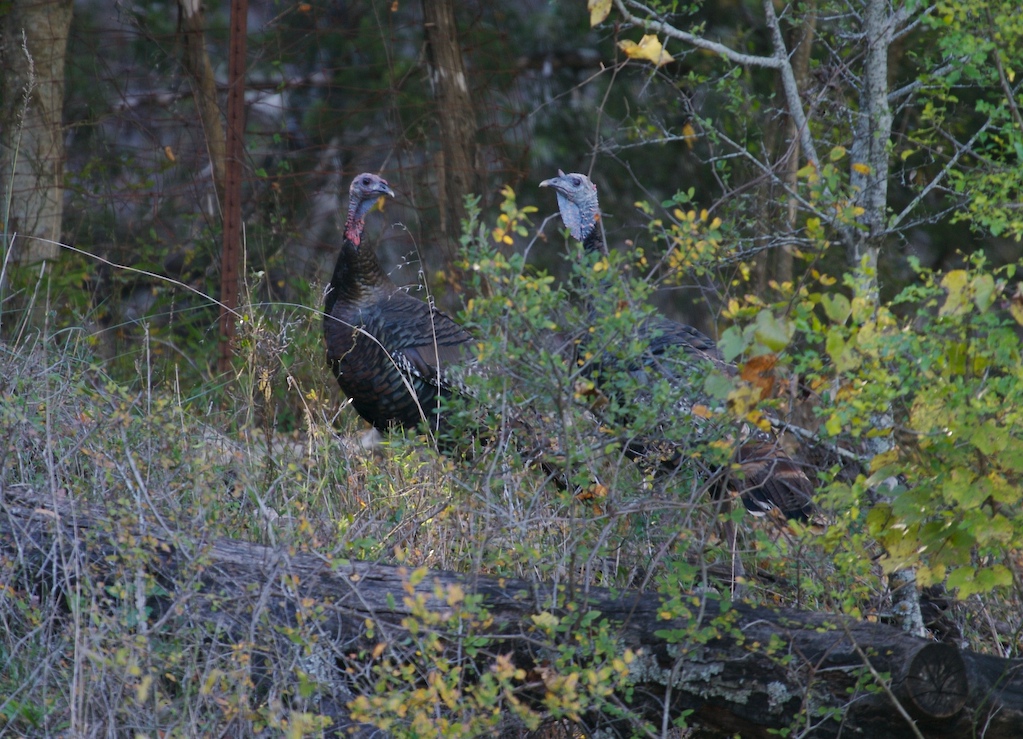
Wild turkeys on the Bamberger Ranch. ©2006 Chris W. Johnson.

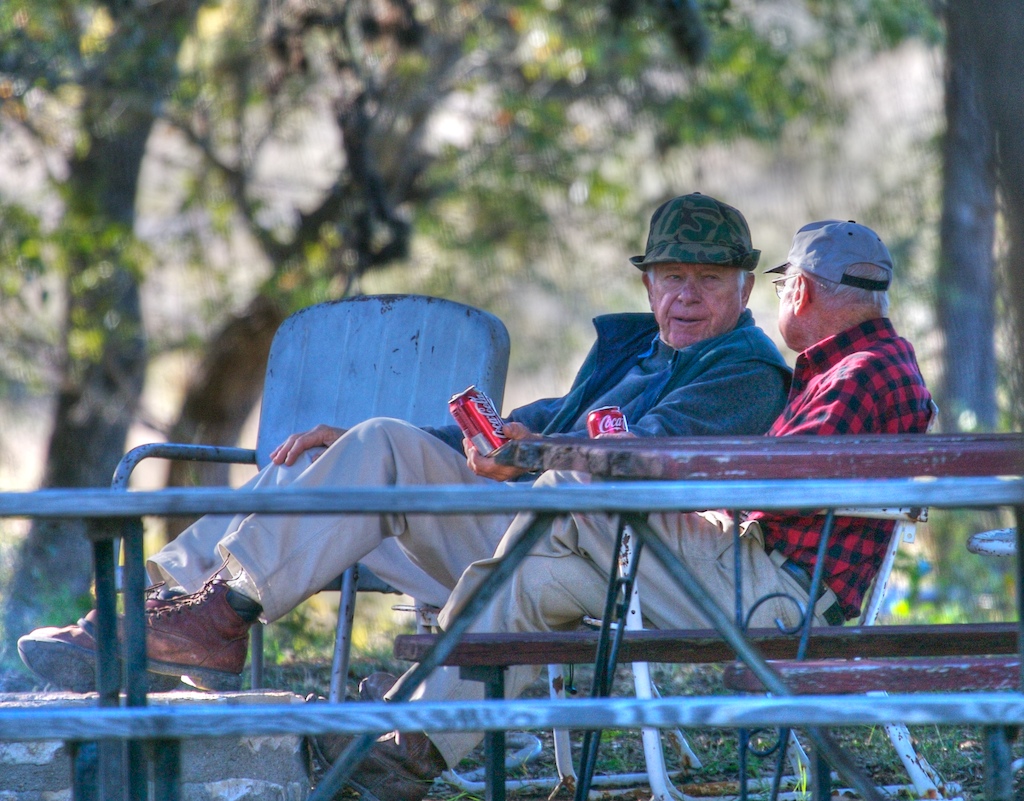
From my most recent visit to the Bamberger Ranch: Above, real, wild turkeys. Below, J. David Bamberger and an old friend.

J. David Bamberger talking with an old friend. ©2006 Chris W. Johnson.

Monday, November 20, 2006

Apple's Backup 3 - Hopeless Junk

What good is backup software that can't perform a restore? That's what I've been wondering in the week since the main hard drive in my PowerMac G5 died. Having lost another drive earlier in the year for which I had no backup, I'd finally setup a proper backup system, using external SATA drives as the destinations, and Apple's Backup version 3.1 (a part of the ".Mac" package) to perform nightly incremental backups. So, my latest drive failure seemed like one failure too many for the year, but one for which I was prepared. Or so I thought until I tried to restore my files. Then I found that Backup 3.1 would only restore a certain number of the files early in the backup set before it would crash. Any attempt to restore other files from the set resulted only in a crash. Specifically, Backup would proceed to very slowly consume about 2.1 GB of virtual memory, and then it would crash, writing the following to "backup.log":

Backup(1104,0x1ace800) malloc: *** vm_allocate(size=1069056) failed (error code=3)
Backup(1104,0x1ace800) malloc: *** error: can't allocate region
Backup(1104,0x1ace800) malloc: *** set a breakpoint in szone_error to debug

As best I can tell, this means that between the 2.1 GB of virtual memory it used-up (as observed in Activity Monitor), it also consumed a further 1.9 GB of combined real, private and shared memory, and then died because its 32-bit address space was exhausted. Brilliant. Thank you so much, Apple, for backup software that can backup, but not restore. That's innovative, alright, but not in a good way.

Needless to say, I submitted many crash reports, and a proper bug report, complete with a plea for help, but none has been offered in the following week.

I have, however, salvaged a fair number of files by manually mounting the ".sparseimage" files hidden inside the backup "files", but with seventy incrementals since the last full backup, sifting through everything by hand is a major problem. And files with resource forks, along with executables, can't be salvaged that way at all. Oh, thank you, Apple.

So, based on this experience, let me warn anyone else out there who's using Apple's Backup program: Don't. If your backup sets are small, it may well work for you, but once they grow large enough, you'll reach the same point I did, where it'll crash rather than restore your files. And you won't know that you've reached that point until it's too late.

S.M.A.R.T.?

As an aside, the drive that died (a 250 GB Maxtor that Apple sold me with the G5) had a controller that supports SMART (Self-Monitoring, Analysis and Reporting Technology), and I had installed the DiskWarrior extension that routinely checks the SMART status of the mounted drives and is supposed to display an alert when a drive reports that it is beginning to fail. No such warning appeared. This is the second SMART-equipped mechanism that I've lost (but the first since installing the DiskWarrior extension), and I haven't seen SMART do a thing. Has anyone out there actually seen SMART do its stuff?

Aperture Vaults

The one thing that did work well in this mess was the backup scheme ("vaults") that Apple's Aperture team integrated into that application. There was no problem restoring from the vault I'd created on one of my backup drives, and because support for vaults is well integrated into Aperture, I'd (1) actually setup a vault (the splash screen gently nags you to do so), and (2) kept it current. If any members of the Aperture team happen to read this, let me just say: Thank you. And please go beat the metaphorical crap out of whoever's responsible for the Backup application; they make everybody else at Apple look bad.

Sunday, November 5, 2006

Failure in a Creek

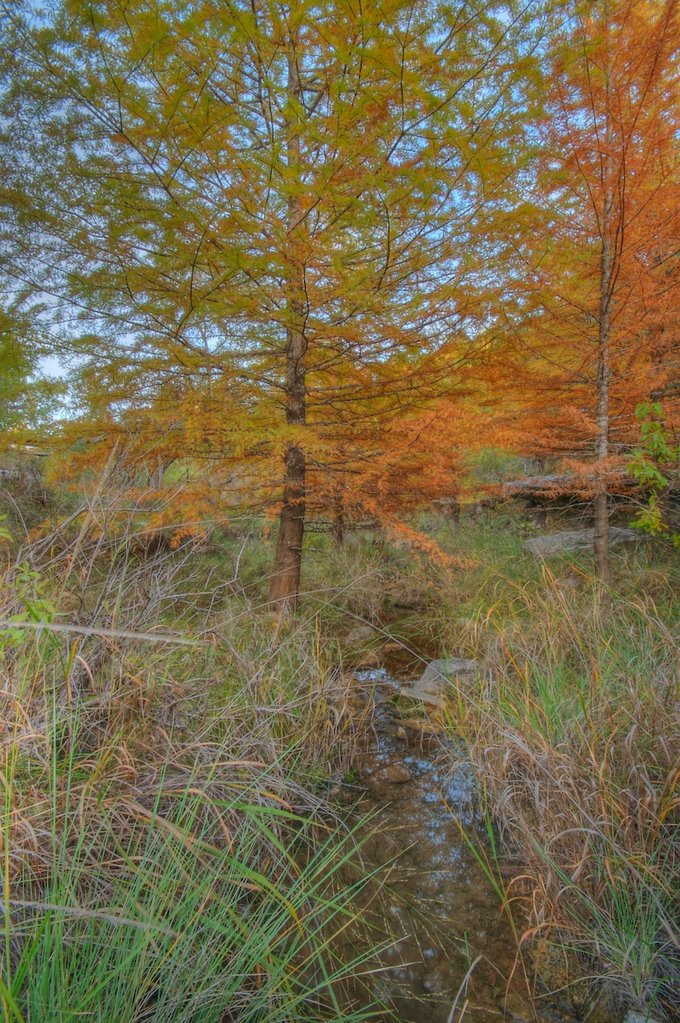
Last Friday afternoon I drove out to the Bamberger Ranch to lend Margaret a hand with her Macintosh, and to shoot some panoramas while the fall color was burning bright, and the valleys were still safely free of gunfire. Unfortunately, I didn't finish with the computer until the sun was well on its way to the horizon, so there wasn't a lot of time to find a good location and get my panoramic rig setup. After a quick consultation with David, I set off for the Louis Bromfield trail, which I was assured was especially worth seeing, and where he figured we'd cross paths later on, as he had some work to do down there.

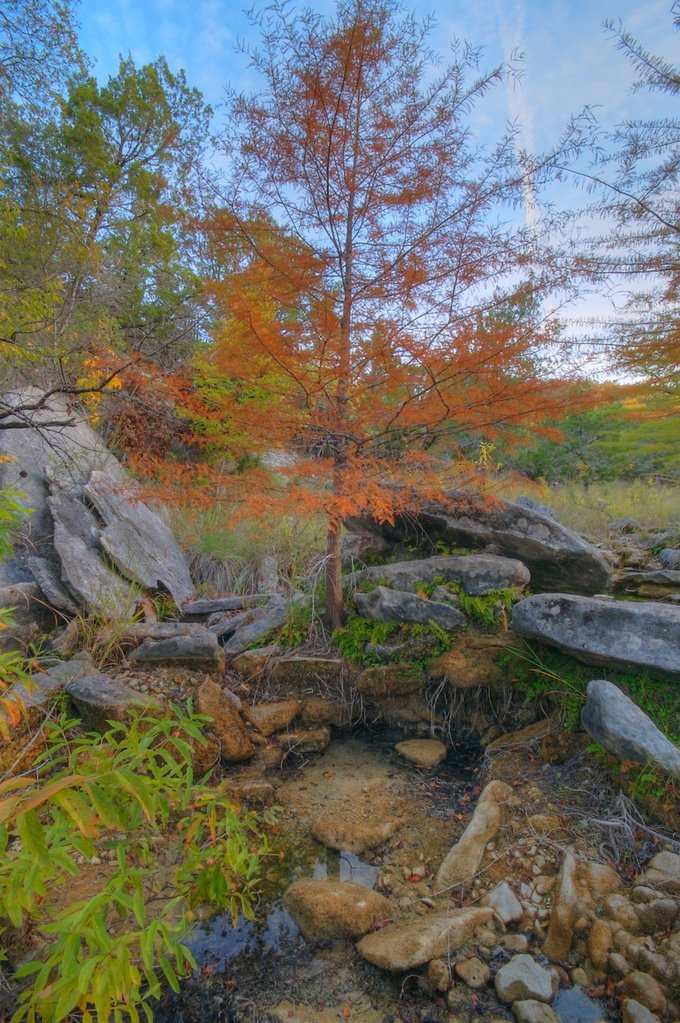
Unfortunately, the first stretch of the trail was hard to distinguish from any of a dozen deer paths, and I headed off into the hills, squandering the rapidly diminishing light as I wandered in what eventually became exactly the wrong direction. When, at last, my mistake became completely obvious, I turned back and eventually intersected the Bromfield trail. It was a shame to lose that time, because the portion of the Bromfield trail that I did see was gorgeous: a creek running down a course cut through limestone, bordered by thick native grasses, and shaded by bald cypress trees in full fall color. Not that the shade was evident, however, because the sun had already settled behind a hill.

Cursing my timing, and daylight savings, I stopped at the first dense group of cypress trees, found my way down to the creek bottom, and hurriedly assembled my panoramic rig astride the creek. I thought I might still be able to shoot something useful, due to the reasonably bright sky, and the flexibility afforded by the High Dynamic Range (HDR) photographic technique I began using in August. It turns out I was right, but, as I learned tonight, in my rushed setup I ruined all of the panoramas I was about to shoot by botching the horizontal alignment of the camera; I read my setup notes correctly, but aligned the wrong bits to the diagrammed positions. Damn.

Lest the occasion be a total loss, I present here the best fragments of the ruined panoramas. The final one was actually shot after nightfall. I had already watched the sun set while I was still looking for a good vantage point. By the time I'd found one, parked my truck so it wouldn't appear in the would-be panorama, sprinted up a valley wall, and setup the camera, night had already fallen. The scene was rescued, if it was rescued, by using HDR to combine three exposures, the longest of which lasted 25 seconds.

Fall color on the Louis Bromfield trail on the Bamberger Ranch. ©2006 Chris W. Johnson. Fall color on the Louis Bromfield trail on the Bamberger Ranch. ©2006 Chris W. Johnson. Sunset on the Bamberger Ranch. ©2006 Chris W. Johnson.

I met up with the Bambergers afterward, and David pointed-out that I must have missed the Bromfield trail, because he'd ended-up working there, as expected, and hadn't come across me. I told my little tale of woe, while silently kicking myself for missing the opportunity to walk one of the most beautifully restored sections of that now famous ranch with the man responsible for it all. It's a lot like having missed a chance to walk with Aldo Leopold through his little piece of Wisconsin's sand counties, or with Bromfield through his pleasant valley. Damn, again.