Showing posts with label Photography. Show all posts

Sunday, January 6, 2013

The Best Screech Owl Photo I Never Showed You

Readers with long memories may recall my mentioning that I'd setup an experiment during the last week of my 2012 screech owl nesting. The experiment was a home-brew motion sensitive trigger for my digital SLR camera, with trigger and SLR mounted such that they could catch the adults as they flew back and forth from the nest box. (You can see the sensor in the photos; it's the white plastic thing with the exposed pale wood behind it, mounted under the owlet rail. The clamp on the bottom edge of the nest box is providing mechanical isolation for the cable running to/from the motion sensor. Yeah, it was a kludge, but you have to get real-world experience before you can know how to finalize a design.) The experiment worked, albeit with a host of first-time-in-the-field problems that meant the experiment lasted only part of one night. Nonetheless, it was worth nearly being killed by a folding ladder with a very poor sense of timing about when it should fold, the frustration of having to cancel the experiment after a matter of hours, etc., because it produced the photo below.

Delivering a june bug to the nest box.
May 23, 2012, 10:47 PM CDT.

This photo shows the delivery of a june bug, probably Rhizotrogus majalis. And I believe it answers my question about the more-or-less round, white food items that I've seen, via the internal infrared camera, delivered year after year, but which I’ve never been able to identify. The beetles roll-up, to the extent that they can, into a defensive shape, and their shells reflect near-infrared light well, so they appear white in such illumination. Combine that with the low-resolution of standard-definition closed circuit video cameras, and there’s not much to go on in terms of making a species identification. However, combine this high-res, color external shot with the internal shots that followed, and the mystery is solved, at long last.

The motion-trigger experiment produced some other photos of interest, too. I’d intended to post all of them sequentially with commentary, but since I keep failing to do that, I’ve started with my favorite, and will take it from there.

Tuesday, December 25, 2012

2012 Owlet Family Portrait

I gather some loyal followers have been waiting (and waiting, and waiting) for the official 2012 Owlet Family Portrait. Well, happy Christmas, and merry holidays; wait no more.

From left to right, that’s owlet 4, 2, 1 and 3 (ages in days: 25.16, 28.15 ±16 min, 28.2 ±54 min, and 27.19). Owlet no. 1 tested its wings on a number of occasions by flying away from the photo shoot, forcing me to drop whatever I was doing to go retrieve the scamp before he/she could go anywhere unreachable (under the nearby brush pile that was the preferred target, for instance). After seeing that no harm came from flying away or being retrieved, owlet no. 2 soon started doing the same thing.

Feeling obligated to return to the nest the same number of owlets I’d borrowed, lest the adult owls decide I’m completely evil (as opposed to my normal status as a mere pest), those test flights, while very sensible on the owlets’ parts (what better time to test those wings properly?), were a bit stressful for me. Mme. Owl, who observed this whole process from a nearby tree, calling to the owlets from time to time, seemed to prefer that they be kept together as well. (Was her message “put up with the annoying monkey; it does this kind of thing, but you’re safe … or the monkey gets my talons in its head”? That was the translation I settled on at the time.)

Anyway, everyone was returned to the nest safely, and Mme. Owl did not swear a vendetta against me, so, as usual, it all worked-out. However, owlet no. 1 must have liked what it saw of the outside world (all of the owlets did) along with the feel of air on its open wings (“a prince of the power of the air”, if my Emerson is coming back correctly), because it decided to leave the nest that very night, shortly after sunset, as is traditional. Owlet no. 2 waited an additional three days before leaving. Was that unusual enthusiasm in owlet no. 1, or was it because he/she was laid three days before owlet no. 2, even though they ultimately hatched within hours of each other? I have no idea.

Study all you want, but never forget that the closer you look, the more mysteries nature offers you. I can’t imagine a better deal than that.

Sunday, July 10, 2011

The Syntax of Photography

From The Keepers of Light by William Crawford, pp. 6–7:

[....] Are there "syntactical" rules of structure for the way we turn objects into photographs, rules that compel the infinite possibilities to fall along a finite line, just as there are rules for the way we turn concepts into statements? How you answer this question tends to determine how you approach the study of the history of photography.

My answer is that there is a photographic syntactical structure for the "language" of photography and that it comes, not from the photographer, but from the chemical, optical, and mechanical relationships that make photography possible. My argument is that the photographer can only do what the technology available at the time permits him to do. All sorts of artistic conventions and personal yearnings may influence a photographer—but only as far as the technology allows. At bottom, photography is a running battle between vision and technology. Genius is constantly frustrated—and tempered—by the machine.

Contemporary sensibility puts so much emphasis on photography as a "creative" activity that we can forget that what photographers really do—whether creative or not—is contend with a medium that forces them to look, to respond, and to record the world in a technologically structured and restricted way. I think that this point is essential to an understanding of photography. You simply cannot look at photographs as if they were ends without means. Each is the culmination of a process in which the photographer makes his decisions and discoveries within a technological framework. The camera not only allows him to take pictures; in a general sense it also tells him what pictures to take and how to go about it. It does this by restricting the field of view. The technology itself has blind spots and often stumbles through the dark. It is ornery and obstinate and sees only what it will. As a result, human experiences and natural wonders that the technology is not yet able to see go unrecorded—and even unnoticed. Each time the technology enlarges its sight, our eyes grow wider with surprise.

Having struggled over the years with stereo photography, including long baseline (up to 150 feet) stereo of moving objects, high dynamic range photography, and, most challenging of all, panoramic high dynamic range photography—each a photographic technique able to capture visions (or versions) of reality human eyes cannot see, while significantly challenging photographers attempting to impose them on the medium of current technology—the passage above rings especially true, suggesting available photographic technology will always fall short of some photographers’ yearnings, while limiting recordable “human experiences and natural wonders.” I admit, however, the “running battle” between available technology’s limits and inspiration’s realization, is an aspect of photography I find engaging (given sufficient energy and resources), and one which sweetens the successes, despite, or due to, their rarity.

Monday, February 21, 2011

White-Tailed Deer Amid Zexmenia

White-tailed deer, Odocoileus virginianus, amid blooming Zexmenia,
Wedelia hispida. Bamberger Ranch Preserve, June 9, 2007.
Photo ©2007-2011 by Chris W. Johnson.

I keep telling David Bamberger that he should share random photos of interest from around the ranch with his blog readers, even if he has nothing to say about the photos, both because it gives the readers a chance to see something of the ranch they might otherwise never see, and because it will fill-in the gaps between his lengthier posts, which should please his readership. I think I have him convinced, but he hasn’t done it yet. In this case, I’m taking my own advice. Enjoy.

Thursday, February 17, 2011

Now Playing on Radio Paradise, My Photos

Radio Paradise, an Internet radio station, that also happens to have been my favorite radio station since a friend (thanks Brendan) introduced me to it many years ago, is now offering a high definition video feed to accompany their music. They’re accepting photos from anyone, provided that the photos meet their admittedly subjective criteria.

I’d been meaning to submit some of my own photos for a while. Unfortunately, I found it surprisingly tough to extract a satisfying 16 X 9 image from my 36 X 11 panoramas, and second-guessed myself into believing that none of the results were good enough. (Some of my favorite panoramas simply had no section to be extracted that was interesting by itself – the completeness of the full panorama turned-out to be essential, at least to my eyes, to the composition and appeal of the image.) However, a few nights back I took a fresh look at the candidate images I'd extracted, discarded more than half of them and submitted the rest just to see what would happen. Late the next day I received a flock of emails from Radio Paradise’s proprietors (one for each image), and, to my amazement, every image was accepted.

So, somewhere within the innumerable images that must compose Radio Paradise’s collection by now, are a few handfuls of mine. The odds of anyone seeing them must be exceedingly small, but tune in and enjoy the music (and everyone else’s photos), and you just might see a familiar name go by.


Thursday, December 30, 2010

Geminid Meteor Shower 2010 Time-Lapse Movie

I’ve taken my 686 photos of the 2010 Geminid meteor shower on December 13/14 and transformed them into the following high-definition (1080p), time-lapse movie, which I hope you will enjoy. It spans 6¼ hours of time in two minutes, contains approximately 34 meteors, several airplanes, and a couple of satellites. Also, you get to watch the sky as it appears to rotate around the polestar, Polaris.

High-definition, time-lapse movie of the 2010 Geminid meteor shower.
87.1 MB, 1080p (1920 x 1080), MPEG-4 (H.264) video.
No sound.

Be aware that if you watch this video in your web browser, and your screen isn’t large enough to display the whole thing, Firefox and Chrome don’t seem to have any support for scaling down the video, but Safari does – just use the “Zoom Out” item in the “View” menu.

The original, 87.1 megabyte, 1080p movie linked-to above is hosted on the Internet Archive, where preservation of the original material matters. For user convenience and accessibility, the Internet Archive also makes it standard practice to offer scaled-down versions of movies, and versions transcoded into other common formats, but I recommend viewing only the original movie in this case – the scaled-down versions are much too small for most of the meteors to be seen.

(By the way, those 87.1 megabytes are real, original 220-byte megabytes, not NIST’s redefined, demented 106-byte megabytes. So, if you download the movie and are told by your web browser or operating system that the movie is 91.3 megabytes, you’ll know that you are being shown politically correct, little megabytes, rather than real ones. Pet peeve. Excuse the digression.)

Creating the Movie

Creating this movie, and getting it properly hosted somewhere, took quite some doing. The original photos were all 18 megapixel raw images in “portrait” (vertical) orientation. They had to be scaled down to 0.78 megapixel images to fit in a “high-definition” (don’t make me laugh) video, then I had to write software to letterbox each frame (if that’s the still the appropriate term when adding vertical bars to the sides, rather than horizontal bars to the top and bottom) while reading each frame’s metadata, so that a correct timestamp could be drawn into each frame. Then those frames had to be combined into a movie, which is easily done with QuickTime Player 7, but all of my efforts to convert that movie directly to an MP4 (H.264) movie seemed to produce quantization errors within the vertical gradation of brightness in the sky. In any case, I wanted to add some explanation, so the QuickTime movie composed of the separate PNG files produced by my letterboxer was imported into iMovie, then a few hours of futzing with iMovie (mostly trying to remember how to use it) were required. After that, there were four or five 30 minute rounds of exporting the movie, viewing it, deciding something wasn’t quite right, adjusting the errant element, re-exporting the movie, and repeating.

Oddly, iMovie 8.0.6 (from the iLife ’09 package) doesn't directly support exporting movies at 1080p, so I had to use its QuickTime export mode, and manually select the relevant parameters. Which is ironic, because, as mentioned, I couldn’t get QuickTime to encode the original movie in H.264 without it adding quantization artifacts to the sky. So, why wasn’t that a problem when using the same QuickTime codec from iMovie? I’m not sure. One possibility is that after all that time, I became oblivious to the quantization artifacts. Another is that iMovie made some adjustments to the movie to bring it within a gamut that QuickTime’s H.264 codec could handle gracefully. (FWIW, I’ve since acquired iMovie 9.0 from the iLife ’11 package, and it does support direct 1080p export – not that that's relevant to the encoding issues, since it'll be using the same QuickTime codecs as its predecessor.)

Publishing the Movie

Creating the movie was only half the problem. The other was finding a site to host the movie. After determining that YouTube will support 1080p high-definition video, my first thought was to publish it there, because (1) everyone is used to looking for video media there, and (2) many Internet-connected high-definition televisions, and related devices like the various high-def TiVos (1080i only, unfortunately), can download video directly from YouTube, which is convenient. Unfortunately, YouTube transcoded the video. Video transcoding is standard practice with YouTube, presumably to make everything compatible with their Flash video player, but also, I suspect, to reduce movie sizes. For some videos the loss of quality isn’t too obvious, but this is not one of those videos. Not only did the transcoding badly blur the fine details in the night sky, thereby eliminating various small stars, faint meteors, etc., but it also corrupted the start of the movie. I had worried about the blurring, but hoped they’d do less of that to high-def videos (wrong). The video corruption, however, really took me by surprise.

One of the early frames corrupted by YouTube.
Compare to the image up top, which is how the frame actually appeared.

My experience publishing on YouTube is minimal, but the possibility that they could still have bugs like that in their video processing system after processing untold millions of videos over the years, hadn’t occurred to me. I reported the bug, but there’s been no follow-up, perhaps, in part, because their bug reporting system, which includes the good idea of allowing you to capture screen shots in order to illustrate the bug, won’t capture any portion of the video on a page (at least not when I tried it in current versions of Safari, Chrome and Firefox on Mac OS X 10.6.5). Since the video was the subject of the bug report, their clever, but not clever enough, bug reporting system backfired quite effectively.

After acquiring iMovie 9.0, which has direct-to-YouTube 1080p video export built-in, I tried posting the movie again. This time it wasn’t corrupted, but the quality of the video is otherwise no better. If you want to compare-and-contrast with the Internet Archive video, you can see the YouTube video below. (Once it starts playing, be sure to go to the pop-up menu near the lower-right corner that’s labelled “240p” and pick the “1080p” option, instead, then expand the video to full-screen, by clicking the icon in the lower-right corner).

Unfortunately, the original, high-quality video available from the Internet Archive can’t be viewed on most (any?) high-definition televisions, not because of video format problems (the video is already in the MPEG-4 format used for high-definition television), but simply because the TVs don’t come with software for downloading video from the Internet Archive (or arbitrary URLs). However, if you care enough (and if your computer monitor is large enough, there’s no reason to care), you can view it indirectly by downloading the video to your computer, copying it to a USB flash drive, plugging that into most HDTVs (typically, there’s a USB port or two on the back), and watching it that way. Not exactly convenient, but it will work.

Wednesday, December 15, 2010

Geminids with a Side of Turkey

I spent the night of December 13/14 in my favorite meteor watching field on the Bamberger Ranch Preserve (thanks to David and Lois, respectively, for making that possible). I was counting, and, most of all, trying to photograph, Geminid meteors. Watching commenced in earnest only after I’d finished setting-up my camera and started it clicking away at 11:56 PM. It was freezing up there, and when the wind blew … much worse. The correct attire for Geminid watching even in the Texas hill country is a zero degree sleeping bag. What my meteor watching brethren in colder territories do to survive, I don’t know. (Layers are probably the key. Undoubtedly a sleeping bag would still be a good start, then wrapping that in a well heated house should just about do the trick.)

Anyway, I gave up at 6:10 AM as the sky started to brighten prior to sunrise. During those 6¼ hours, I counted five hundred and five meteors (a personal record), ranging in appearance from so faint they were barely visible, to bright enough that they briefly left a little glow in the sky after they burned-out. My camera seems to have caught at least 34 of them, but I wouldn’t describe any of the photos as remarkable. The best meteors, as usual, fell outside the small patch of sky I was photographing – though they were everywhere else at one time or another. Disappointing, but you can’t win, if you don’t play. (Conversely, if you don’t play, you also can’t loose.)

More later.

And now, a flock of wild turkeys I surprised as I was heading out of the ranch. This photo captures only a tiny fragment of the flock, but they started flying into the trees or briskly striding away even before I’d managed to stop the truck and grab the camera that I had ready & waiting for this eventuality. Still, I’ve been bumping into this flock for years, and this is the best turkey photo I’ve come up with so far.

Friday, September 24, 2010

Bamberger Ranch 2007 vs. 2010 – Compare and Contrast

David Bamberger recently posted an item on the Bamberger Ranch Journal showing photos of the water flows created by the rains brought by tropical storm Hermine on September 7th and 8th. I have at least two images in my files of areas pictured in David’s blog entry during the ranch’s last “wet year,” 2007. Bamberger Ranch Journal followers might find the contrast adds some perspective to David’s photos.

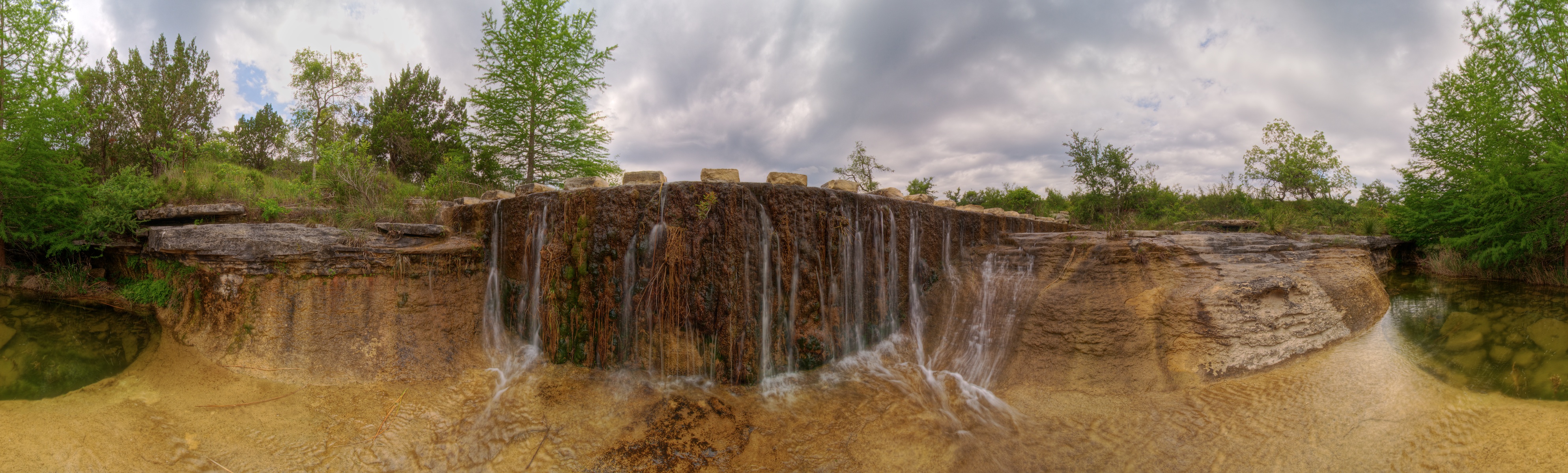
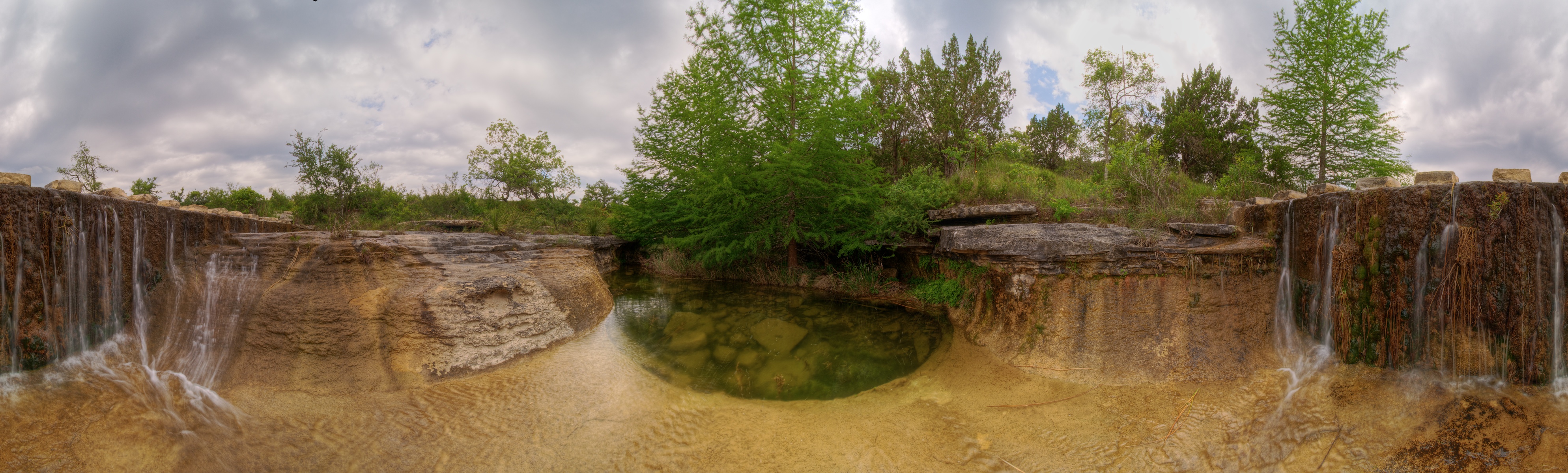
Above is the dam on the Bromfield Trail, as seen from the foot of the dam, with the outflow channel split between the left and right edges of the image. You can see the stepping stones David refers to along the top of the dam. Plenty of water was flowing, but nothing compared to the flow Hermine produced – 3⅓ years later I’d’ve been standing in around six feet, or more, of torrential flow. (This panorama can also be seen in my preferred composition, with the dam split and the outflow channel centered.)

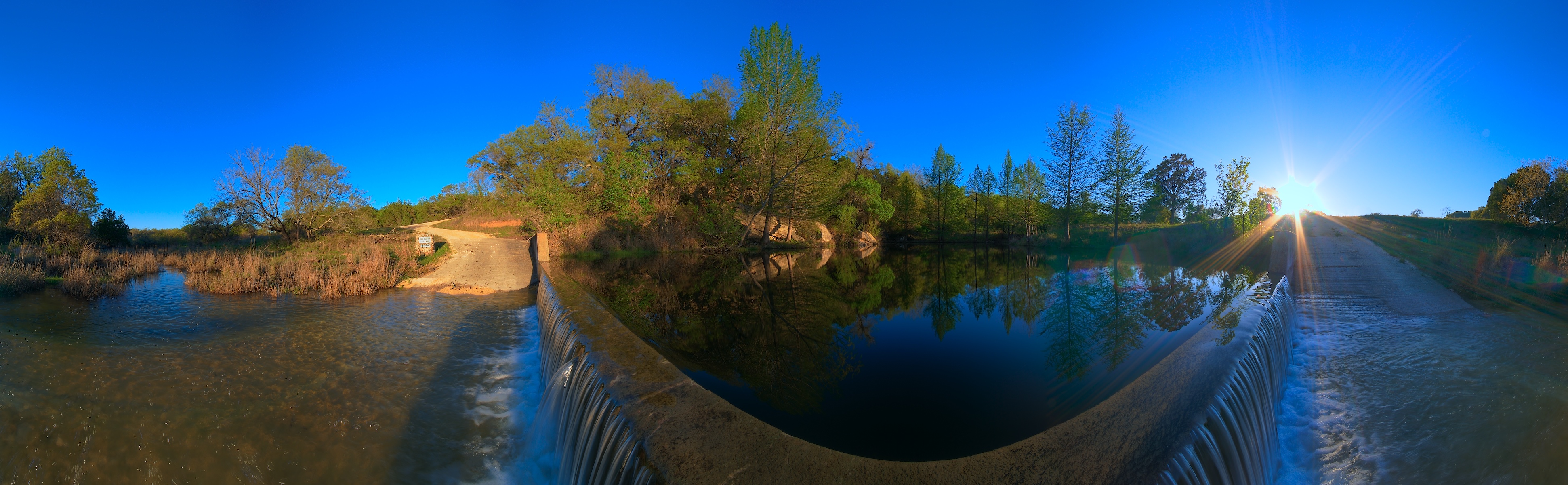
The panorama above shows the area identified by David as the “low water crossing leading to the Aldo Leopold Trail.” The most significant element is the dam that forms one end of the Jacob’s Ladder tank. In David’s photo, that’s seen on the right side of the image. In this panorama, which was shot at roughly the middle of the dam, it’s the curving central feature of the piece. At the time I shot that panorama, I was standing in something like 10 inches of lightly roiling water – an exceptional flow in its own right, which had turned the grassy areas above the stream banks (seen on the left side of the image) into a marsh. In David’s photo it would be more like 2½ or 3 feet of knock-you-off-your-feet water, and those grassy areas are completely underwater.


A photographic aside: While the Jacob’s Ladder dam is straight, my panorama is not wrong to portray it curved. If you were to stand in the same place and look at the dam, the image of the dam falling on your retinas would also be curving away into the distance. You can understand the basis of this effect by drawing an overhead diagram with yourself as a point and the dam as a straight line. Now draw straight sight-lines from the point, representing one of your eyes, to various locations along the length of the dam’s straight line. Those are just some of your many lines-of-sight in the scene. The diagram makes it obvious that the sight lines to the portions of the dam furthest from you are the longest, and that they shorten as they approach the portion of the dam directly in front of you. The differences in length among the sight-lines increases as the point is moved closer to the line representing the dam, and therefore the closer you are to the dam, the more pronounced is the effect of perspective. (In this case, I was standing very, very close to the dam – as close as the legs of my tripod would permit.) As you know from everyday experience, objects appear smaller as the distance to them increases, so it follows that the portion of the dam directly in front of you will appear more-or-less “full size,” while the more distant parts will appear smaller. Because the effect is continuous (rather than discrete, as in the case of the lines in our diagram), a smooth curve of decreasing apparent size results. (More formally speaking, the portions of the dam subtend progressively smaller angles on your retina as the distance to them increases.) It’s our brains that straighten-out our perception of the lines. (That straightening is generally useful, but is also the cause of certain optical illusions. So, our brains’ attempts to “correct” our perceptions sometimes distorts them instead. Thus, there is no free lunch in perception.) In our cameras, unless we’re shooting with fisheye lenses, special optical elements in the lenses perform the same rectilinear correction (sometimes adding extra chromatic aberration in the process). In order to assemble a panorama, the panorama stitching software must undo the rectilinear correction in the lens, thereby restoring the true perspective of the images and allowing the common features in the images, especially those furthest from the center of the images, to naturally align with one another (assuming the panorama is photographed without mistakes like parallax errors). Thus the “straight” lines in the image return to their original perspetive-bent appearances.

In panoramas representing a field-of-view of 180°, or less, it is possible to subsequently restore the rectilinear correction, as was done in my recent panorama of the U.T. Austin Main Building and Tower. Note, however, that elements near the edges may have an increasingly implausible appearance of their own in such corrected images. They appear implausible to us, because our eyes can’t show us comparable fields-of-view, and therefore we are not accustomed to that degree of rectilinear correction.

Monday, September 20, 2010

U.T. Austin Main Building and Tower, Predawn

Most photos of the U.T. Austin Tower neglect the Main Building, which is its base. While shooting some test panoramas the other night, I thought I’d take a different approach and emphasize the Main Building. To get all of the Main Building and Tower into the photo, I shot this as two rows of three photos. Every photo was shot at three different exposures, 3 stops apart, so that a high dynamic range (HDR) image could ultimately be created. The photos at each exposure were stitched together and projected rectilinearly to form a 172 megapixel image. Each of those images was then cropped down to 72 megapixels, and combined into a HDR image. The HDR image was tonemapped, then cropped down to 65 megapixels to create the image above. Blogger, which seems to be allergic to large images (probably because it’s a free service), has subsequently scaled-down the image to a mere 1.5 megapixels. Hopefully, it’s still of some interest.

It’s worth noting that the photo was taken at night, while the sky was about as black as it ever gets in this city. However, the 15 second, ISO 400 exposures that captured the dimmest details in the scene were able to find color and detail in the sky that was invisible to the naked eye. This is one of the pleasant surprises sometimes associated with the HDR process.

Architecturally, one of the interesting things about the U.T. Austin Main Building and its Tower is that they were built at different times. The Main Building, if memory serves, dates back to 1933. The University knew it wanted a tower added to the building, so a space was left for it with a conceptual “insert tower here” marker on it. Years after the Main Building was complete, a design competition for the Tower was held and the selected design was built in the space reserved for it in 1937. They appear to be a single, seamless structure, but internally they are disjointed, which causes a lot of confusion among people looking for the elevator to the second and third floors of the Main Building, as the elevators and the floors of the two buildings are separate, even though they are both accessed from the first floor of the Main Building.

The Tower is a symbol of U.T. Austin, and one of the city’s great landmarks. I have a particular fondness for the Tower, because I’ve been fortunate enough to have an office on its 25th floor for many years. Regrettably, I will be forced to move to an office in another building in October. In my University career, I’ve had far worse offices than the one I’ll be moved to, including offices in an old machine shop across the hall from the University’s nuclear reactor, a desk in the wide part of a hallway in what had once been the furniture repair shop, and even—during my years in exile—an office out at the University’s Balcones (AKA “Pickle”) research campus (in the Commons building, just down the hall from our Cray supercomputers). For all of their problems some of those offices were quite interesting, but none can hold a candle to my Tower office – the views from up there are among the best in Austin. I’m really going to miss the place. If only I could get visitation rights....

Sunday, May 23, 2010

Screech Owl Nesting Complete

Owlet no. 3 (the last of the two owlets that successfully hatched from the four eggs that were laid), left the nest box around 9 PM last night, and successfully climbed its way to safety in the high, outer branches of the nest box tree. The picture above shows owlet no. 3 beginning that climb.

So, that’s pretty much that for the 2010 nesting season. There may be a few more updates if I catch sight of the owlets over the next week. But they won’t be going back to the nest box no matter what (once they've left, they don’t go back - their instincts appear to operate in one direction only in this matter), so I’ll be shutting down the “live” video as soon as I get around to it.

Thanks to everyone who watched, and especially to those who sent postcards.

By the way, over the last month, Google Analytics shows that the site had 11,271 visitors (no, I don’t know who you are), 192,052 pageviews, 17.04 pages/visit, almost 18 minutes average time on the site, and 24.18% new visitors – and those stats are on the low side, because views of the daily highlights pictures are not recorded. Visitors were primarily from the United States (10,595), but Germany supplied 222, the United Kingdom 162, Canda 134, the Netherlands 30, Hungary 27, France 11, Finland 8, Ireland 6, Australia 5, the Czech Republic 5, New Zealand 3, Turkey 3, India 3, Denmark 2, Malaysia 2, the Philipines 2, and Japan 2. (I’ve omitted the 49 other countries that only supplied one visitor in order to keep that list short.) Anyway, welcome to everyone and I hope you enjoyed it.

Thursday, May 20, 2010

The 2010 Models – Eastern Screech Owls

I brought the owls’ nest box down early this morning and attached the owlet rail outside the entry/exit hole (see the final photo). This was done in anticipation of the eldest owlet leaving the nest soon, and in the expectation that having a perch outside the hole must make that critical leap from nest to tree easier.

This also gave me an opportunity to open the nest box and take some family portraits. Above, I believe, is the eldest owlet. Below, poorly photographed, is the youngest owlet. I also meant to photograph unhatched egg no. 4, but it wasn’t immediately evident, and searching the bedding materials for it seemed like it would be an unnecessary disturbance to the owlets. (I can dig it up after the owlets are gone.)

And below is what the nest box looks like with the owlet rail attached to the front. (There’s a paper towel temporarily to stuffed into the entry/exit hole to calm the owlets, but, otherwise, it looks much the same once it’s been returned to its rightful place in the tree.)

Needless to say, this threat to the nest and owlets resulted in repeated attacks by the adults, from which my scalp probably carries a good number of scratches, all well-deserved. And all in a good cause.


Remember, you can still watch the activity in the nest more-or-less live. It won’t be long before the owlets are gone for the year, so, if you care about this sort thing, watch while you still can.

Photos of the Adult Owls

Here’re the promised photos of the adults. Don’t ask me which is the male and which is the female – unless I was lucky enough to observe sexually distinctive behavior (like tearing up prey and feeding it to the owlets, which only the female will do), there’s no way for me to know.

Alternately, if both owls suddenly took leave of their senses and let me get hold of them, I might be able to determine their sex by weighing them, because females are generally heavier than males. (That’s known as “reverse sexual size dimorphism,” if you want to impress your friends.) However, there’s some overlap of their normal weight ranges, so even weighing them doesn’t guarantee an answer. Fortunately, somehow, the owls have it all figured-out.

Monday, March 29, 2010

In Which I Appear on the Bamberger Ranch Blog

I've just learned that I'm putting in an appearance on the Bamberger Ranch Journal this week. Thanks, David, for the kind words, and for plugging the owl cam’. (BTW, that blog post was delayed not by David, but by me, because I haven't been checking my email often enough while I've been out of the office letting my knee heal.)

Anyone viewing that blog entry should be warned that there’s no such thing as a good picture of me. I can’t produce a smile on command that doesn’t scare children. (Well, probably. I haven’t actually tested; there are, after all, ethical issues relating to human testing, especially on children.) I don’t even seem to be able to reliably arrange my features in a neutral, but moderately photogenic pattern. This has produced more than a few problems over the years, including the occasion when I had to supply a head shot to the Ladybird Johnson Wildflower Center when a show of my panoramas was taking place there a few years back. I took about eighty shots of my head, until the futility of the exercise wore me out, and I settled for something neutral and, at least, not obviously frightening. (That's the photo on my home page at the moment; one of my favorite panoramas—taken on the Bamberger Ranch, BTW—is hanging in the background.)

By the way, folks in the Austin-area can still see that and four other of my panoramas on display over at the New World Deli, where they seem to be on semi-permanent display (17 months and counting), and the owner is threatening to buy the lot, if I’ll set him up with a payment plan.

Folks out in Johnson City can still see (and buy) one of my other panoramas that is on display in the Johnson City Public library. I believe it’s in the new Natural History section endowed by David & Margaret Bamberger. Appropriately, that pano was shot on the Bamberger Ranch one day when Margaret and I were making the photographic rounds of the place. I’d been trying to shoot a good pano in that meadow for three years, and that day everything finally came together.

Another Showing

I’ve been offered the chance to show my work as part of a monthly, one-night show here in Austin late next month. If I can get my act together in time, I’ll print replacements for the items that’ve sold during the extended Deli show, and will also show two panoramas that haven’t been printed before. I’ll post more details when I’m more certain that I’ll be up to participating.

Sunday, February 28, 2010

A 2nd Year Cooper’s Hawk

A recent visitor to my bird feeder, identified by Sallie, my raptor rehabber friend: “This is a 2nd year Cooper's Hawk. Just the species I’d expect to go for your sparrows. (Hatched in 2009.)” … Just one of several ways that my bird feeder feeds birds. This hawk is welcome back anytime. Unfortunately for it, but fortunately for the sparrows, she/he may not want to come back. The pile of branches on which it is perched is a pile a of branches I keep near my bird feeder both to provide small birds with shelter from potentially lethal winter winds (not that we get a lot of those around here), and from predators like this hawk. I don’t begrudge the hawk any prey it can get hold of, but, by the same token, I begrudge none of its would-be prey a safe hiding place and the good sense to use it. What’s a good day for prey like a house sparrow is a bad day for a Cooper’s Hawk, and a good day for a Cooper’s Hawk is a bad day for its prey. Generally speaking, I wish prey and predators their equal shares of good and bad days, so that both may survive. (Of course, because house sparrows are an invasive, introduced species, the hawk is welcome to eat every last one of them in the Americas, as far as I’m concerned. Maybe then I’d start seeing some of our native sparrows.)

By the way, the “2nd year” designation means that this bird was born the previous year. At this point he/she is not quite one year old. By the time he/she is fully mature at 5 years of age, the irises of its eyes will have turned red, its breast will be predominately red, and its back will be a dark, gray-ish color.

Saturday, February 13, 2010

The Moon – Been There, Done That


Our Moon, Third Quarter, February 5, 2010.
©2010 Chris W. Johnson

While I’ve had my back turned in recent weeks, the Obama administration announced the scrapping of NASA’s Constellation program to return astronauts to the moon, explore asteroids, service distant space telescopes, and lay the groundwork for human exploration of Mars. I’ve since read several articles about this, and still have no idea what the new plans for our human spaceflight program are. It’s not even clear to me that the Constellation goals have been abandoned, but Constellation, itself, is history. Whether that program was the right way to accomplish those goals, I don’t know. (Although, development of the Ares V heavy lift booster strikes me as a good idea, regardless; having a tool like that available creates a lot of opportunities.) It does, at least, seem clear that Constellation was inadequately funded to accomplish its original goals in a timely manner, if at all. While some of this bothers me not a bit—I think human exploration of Mars is a bad idea for the foreseeable future (contaminating a planet with humans, and whatever other Earth biota they bring with them, is a not an aid, but a hindrance, to searching it for its own unique lifeforms)—I’d have liked … really, really liked … to see us go back to the moon.

The oldest, and seemingly most common objection to human lunar exploration dates back to the Apollo era and is that it costs too much, and we need that money elsewhere. The most common reply to such concerns is that NASA is a tiny fragment of the federal budget (currently less than 1%, if memory serves), so, even with some budget increase to support a crewed lunar program, if you’re looking for money for other projects, there are a lot of agencies whose budgets can be raided to far greater effect. A less common, but at least equally important response, is that the only things “lost” to space exploration are the hunks of metal, plastic, etc. that we fling into space (or into the ocean, along the way). We loose no money to it - all of the money stays on Earth, where it supplies good paying jobs and tax revenue. (My own job has nothing whatsoever to do with the space program, I hasten to add. Money-wise, I have no stake in this, other than being an American taxpayer.)

Yet another objection has more weight to it, in my opinion: That human space exploration is expensive, dangerous, and, beyond low Earth orbit, exceedingly rare, and not currently possible; therefore, we can do exploration cheaper, safer, and more often if we do it robotically. I agree with that argument. But the political reality is that we will have human spaceflight – the money associated with it flows into too many congressional districts for abandoning it to be politically tenable. And even I don’t want to see it abandoned – I just want to see it go someplace for a change, and not cannibalize the robotic exploration programs as it does so.

But there’s yet another objection that I’ve been hearing more and more in recent years, which is: “been there, done that.” That one takes my breath away. It’s like the tourist who visits the Grand Canyon, stops at a few scenic overlooks, maybe takes a donkey ride, and then crosses it off his list of places to see. Been there, done that. That there might be something more in those ≅2,000 square miles than was apparent during his hit-and-run visit never occurs to him. (And those who would never visit at all, because “it’s just another hole in the ground,” make even our hit-and-run visitor a master of insight by comparison. Their lunar equivalents might choose a phrase like “just rocks, dust, and more rocks,” but the failure is the same.)

The moon doesn’t offer us the life and color that a natural wonder like the Grand Canyon does, but it is a natural wonder nonetheless, covered with mountains, valleys, plains, extinct volcanoes, and even caves, that no human eye has beheld, except, perhaps, in glimpses from orbit. So, yes, we’ve been there, like the hit-and-run tourist. But have we “done” it? The notion is absurd. And if we go back without including in every crew an Ansel Adams-grade photographer, complete with the digital equivalent of a large-format, bellows camera, to climb those mountains, walk those canyons, and capture those sights for us, we’ll have cheated ourselves. Think of the moon as the greatest, remotest (inter)national park that Earth has, and one that only 12 explorers have even set foot in, and then imagine that we’ve seen everything worth seeing, and know everything worth knowing. I can’t.

Tuesday, January 26, 2010

Refracted Moonlight

Moonlight refracted in a passing cloud at about half-past midnight. The moon is too overexposed to be distinguished, and the cloud is blurred by its own motion during the moderately long exposure required to capture its subtle colors, but the rainbow of colors in the cloud is clearly visible. (A little saturation enhancement helped, too.)

I can’t recall having seen this phenomenon before. Maybe I just haven’t paid much attention to such things heretofore, or maybe there’s something a little unusual about the cloud. It’s cold here tonight, so perhaps the cloud is composed of ice crystals, each functioning as a tiny prism. Pure speculation on my part—this isn’t one of my fields—but, whatever the cause, it seemed to be worth trying to get a photo before the cloud passed.

Monday, December 14, 2009

Geminids, Margaret, You Were Missed

The weather forecast didn't look promising, but, sunset arrived and our skies were still clear, so I threw my meteor photography gear in the truck and headed for the Bamberger Ranch. After a very nice dinner with David and Joanna in front of the fireplace, we headed out to see the meteors. They headed for the area around the observatory, because it was close; I headed out to the windmill near the red pens – my standard location for some time – since I can incorporate the windmill into my photos to good effect. The Milky Way stretched overhead clear and bright as my truck trundled to a halt near the windmill. There followed the usual tedious unloading and setting-up, and the difficult focus adjustment trial-and-error (focusing on infinity doesn't do the trick). Then the skies closed, and the best meteor shower of the year vanished. I waited out in the dark cow pasture as the wind hurtled past, making the night much colder than it claimed to be, and shaking even the truck as it went. Hours later, I gave up, just as the peak should have been happening. The sky had cleared briefly once or twice, but the clouds rushed back just as quickly as they left. All in all, I think saw only 11 meteors over the course of those cold hours. Most of that time, I was lucky to see a star.

Above, my one meteor photo of the night, caught, purely by coincidence, as one of the focus-checking shots. (View it full-size, and look in the lower-left quadrant.)

I'd been looking forward to this shower all year. Margaret Bamberger and I had even made plans to watch it. But it didn't work out. (Oh, holy crap, how it didn't work out....) Now the long wait for next year's showers begins. And as for this year, I'll be glad to be done with it. Good riddance. I'd dance on its goddamn grave, if it were to have one … and if I could dance.

Sunday, November 15, 2009

Bamberger Ranch Preserve Gets an Observatory

I finally get to show my photo of the XXXXXXXXXXX that David Bamberger embargoed until he could make his official announcement on-line: The Bamberger Ranch Preserve now has an observatory, as you can see below.

That was a 30-second, ISO 400 exposure shot by moonlight using a 10mm lens at f/4.5. Because the auto-focus system on my camera didn't have enough light to operate, the focus was accomplished with a bit of luck and a binary search.

The observatory will be a great addition to the Preserve's education programs, and is located within an easy walk of the the Center (see my panorama of the main room of the Center), where groups of school kids come to spend as many as three days participating in educational activities. For myself, despite the moonlit sky, I was able to see Jupiter’s clouds first-hand, for the first-time in my life.

Sunday, November 8, 2009

Enchanted Rock State Natural Area, Panorama no. 8

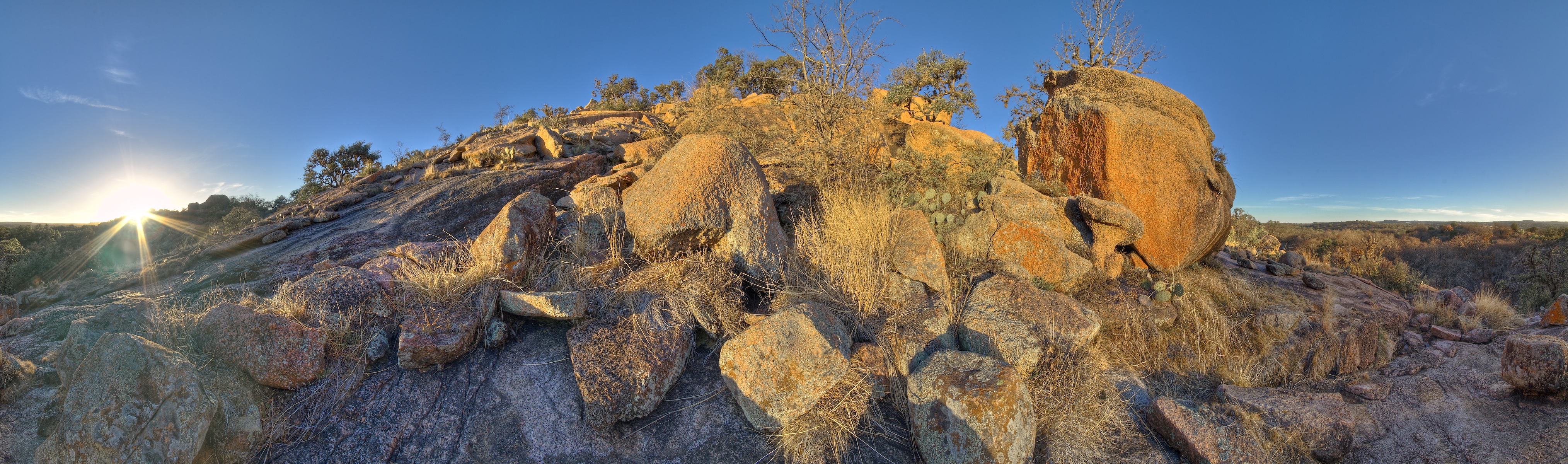
This panorama was shot at sunset on December 29, 2008, at Texas’ justly famous Enchanted Rock, a billion-year-old granite dome exposed by eons of erosion. This was shot on one of the boulder strewn slopes, as the sun was rapidly disappearing beneath the horizon. The lighting changed so much during the shoot that I was sure this panorama was a write-off, but this weekend I decided to assemble it anyway, thinking that one or more subsections might be usable and interesting. Surprisingly (to me at least), modern panorama generating software was able to compensate for the continuously changing lighting, and produced, with a little effort, a pristine 360° image. And, because the pano was shot high dynamic range, the ever deepening shadows caused no loss of information.

This was the only panorama I managed to shoot that day. My earlier attempts to shoot a panorama whose centerpiece would have been a boulder about as big as a small house, failed when I had, with great care and not a few misgivings, setup my equipment on the absolute edge of the furthest point of the ledge on which it sat, and found that the boulder still didn’t fit entirely in frame, even with my 10mm lens (which was acting like a 16mm lens on the camera I was using).

I’d planned to spend two days shooting at Enchanted Rock, staying overnight at the Bamberger Ranch in between, but I was so disgusted at that first day’s failure (and the amount of time I wasted in getting there by following an absurd “short cut” to the Rock that Google Maps had selected for me, and the staggering number of people that were there, and the difficulty/danger of climbing to obscure boulders while carrying 40lbs of camera equipment), that after dinner with the Bambergers (and Leroy Petri) I decided to throw in the towel and just go home. At the time, Margaret said she’d like to join me at the Rock for a day of photography, and we’d planned to do that this past summer. Sadly, she died before that could happen.

What’s the line from the Death Cab for Cutie song (What Sarah Said), “every plan is a tiny prayer to Father Time”?