
From the same sunset in the Bamberger Ranch’s Sun Valley when I encountered the clan of feral pigs, I bring you the oddity of a tree-dwelling cactus (a prickly pear, I believe), because when am I ever going to find another excuse to show this photo?
From the same sunset in the Bamberger Ranch’s Sun Valley when I encountered the clan of feral pigs, I bring you the oddity of a tree-dwelling cactus (a prickly pear, I believe), because when am I ever going to find another excuse to show this photo?
I went out to the Bamberger Ranch Preserve on August 19th to do some work on David Bamberger's computer, see David, and take in the sights. David's computer was doing fine, but David and the sights weren't doing well at all. David was/is being tortured by a case of shingles, and the land is suffering severely from our drought. Allow me to demonstrate that last point visually:

Above is what ranchers call a "tank", a water storage area, frequently artificially constructed or enhanced, intended to provide livestock with access to water. This one is artificial and constructed at the head of a valley. I shot the photo while standing on the right end of the earthen dam that should be retaining the tank's water. You can see a straight line depression in the earth running from the lower center of the picture to the right and down; that's the spillway for handling overflows. This tank, at its deepest, is maybe six feet deep when full, but is generally of a shallow and broad character. When it's raining, the tank is fed by runoff from the plateau above and the surrounding valley walls. The rest of the time it's fed by a spring. At this point, however, it's no longer fed by anything at all. Normal rains haven't come for more than two years, so there's no runoff, and no recharge of the aquifer that feeds the spring. If you didn't know it was a tank, it'd be easy to mistake it for just another area of dusty, sunburned land.
Indeed, the landscape was so transformed that it wasn't until I reached that tank, that I realized I wasn't even in the valley I thought I was in. The last time I'd visited this particular valley was in April of 2007, when its entrance was a sedge meadow, with a steady trickle of water running through the middle of it, as seen below, in a subsection of a panorama. Needless to say, it looked nothing like that during my latest visit, though it didn't occur to me at the time to take a picture of what it did look like, unfortunately.

But that was a small valley. Its neighbor is much larger, which means much larger runoff and recharge zones, a better spring, and a tank many times the size of its neighbor. I was amazed to find that it still held water, but it had very little, and what there was of it looked thick and of a poisonously orange color. It was supporting a group of turtles, but I don't imagine that there was much else left alive in it.

To fully appreciate the effects of the drought on the state of that tank and the surrounding land, it helps to see it under good conditions. Because I've been photographing that valley for years, I happen to have a shot of that tank (a portion of a heretofore unreleased panorama) in my files. So, below is the same tank, seen from about twenty feet to the right, on April 21, 2007, a year when the normal rains did come, if only during the spring. The tank isn't full (the water level is well below the spillway on the right), but it's in good shape and the land is downright verdant by comparison to its current state.

This is a hint of what the central Texas hill country can look like, if the land is well managed, and our yearly ≅30 inches of rain falls. It's a fair first approximation, to this Texan's eyes, of paradise. But, as I said, it's only a hint because, if memory serves, we'd had about nine years of sub-normal rains prior to the fall of 2006 and the spring of 2007, and the rains went back to sub-normal shortly after that spring.
My recent visit to that parched tank did bring one pleasant(-ish) surprise, however: an encounter with a feral pig. (At first I thought it was a javelina, which would have been truly pleasant, but, not having seen a javelina in around thirty years, my memory of their appearance turned-out to be in sad shape.) Due to the drought, she was very lean, and the six piglets with her were still quite small. The piglets stuck to the shadows under nearby brush, while mom and I stood there for some time in the punishing afternoon sun. When she finally turned to take a good look at me, she soon trotted away, up a trail, with the piglets in tow.

Below, by way of comparison, are a few members of a feral pig clan that I encountered in the ranch's Sun Valley, near sunset, during the lush spring of 2007. There was nothing lean about them.


The feral pigs are a problem, unfortunately, not only because they are an introduced species, but because they engage in damaging behavior including: the creation of wallows; the destruction of ground nesting species such as turkey, quail, rabbits, and others – even deer fawns; they damage fences; and on rare occasions they will go so far as to attack people. They are also likely to be competing with the increasingly scarce (and still actively hunted) native javelinas for habitat. However, on that April evening, in that valley, with plump piglets happily chasing one another through deep grass, and the adults contentedly rooting around, the scene was rather idyllic.
It's just occurred to me that I've done my fellow photographers a disservice by not disclosing the photographic details of my recent Perseid meteor photography. That's easily rectified: I used a Canon Digital Rebel XTi (400D) with a Sigma 20mm, f1.8 lens. The camera was set to full-manual mode with the aperture at f1.8, the exposure duration set to 30 seconds, ISO to 400, and capture mode to RAW. It was equipped with an 8 GB storage card, a battery grip (so it had two batteries to draw from), and a shutter cable release that can be locked down such that the camera takes pictures continuously. The lens was set to manual focus, and focused to just shy of infinity. I don't know why, but actually setting the lens to infinity produced out-of-focus stars. So, some experimentation was required to get an acceptable focus. Significantly, the lens was wrapped with a Kendrick FireLite lens warmer powered by a small car battery [my thanks to Chris Cooley for bringing that product to my attention]; without that, even on that summer night in a drought, the lens would have become fogged by dew (my truck was covered with it).
I can easily conceive of better setups (a camera with a full-frame sensor and/or a much wider-angle lens, f1.8 or better), but this setup works, even if the best meteors seem to inevitably fall outside of its field of view.

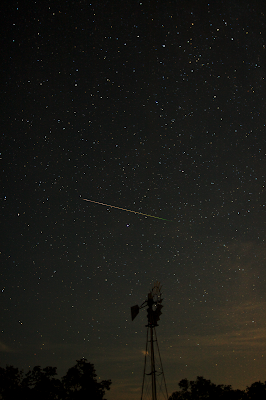
My second-best meteor photo of the night. ©2009 Chris W. Johnson
12:34:56 AM, August 13, 2009.
Bamberger Ranch Preserve, Blanco County, Texas
See the 2009 Perseid meteor shower as I saw it, albeit in 49 seconds, rather than four hours and fifteen minutes. The huge change in illumination over the course of the movie was caused by the rising of the moon.
This movie is 60 MB, and if any meaningful number of people attempt to download it on the same day, it will probably exceed my ".Mac" daily bandwidth limit. Sorry for the inconvenience, but it was too pretty a sight to show in low-res, or to compress into pixelated mush.
(And, of course, services like YouTube can't handle high-res video, or video in non-standard aspect ratios; in short, they can't handle any of my videos. Useless, bloody, one-size-fits-all, "good enough" solutions. I seem to have been born a square peg in a world of round holes, and these sorts of small-minded limitations are among the banes of my existence.)
Anyway, enjoy.
MPEG 4 Video, 647 x 972 pixels, 49 seconds, 60 MB
Perseid Meteor Shower
12-13 August, 2009
11:33 PM - 4:08 AM CDT
Bamberger Ranch Preserve,
Blanco County, Texas
©2009 Chris W. Johnson

Yesterday, I finally took a decent photo of one of Texas’ many nine-banded armadillos, our state mascot. (Originally, legislators tried to make it the state mammal, but other legislators with strong anti-armadillo biases scuttled that effort. Mascot status was a compromise.) Although, as the link above emphasizes, the nine-banded armadillo only recently arrived in the United States (sometime around 1870 it had crossed from Mexico into Texas), it's worth noting that North America used to have a widespread species of "giant" armadillo, about twice the size of the nine-banded, that went extinct. (And that's without going back to the fossil record, which shows that we once had armadillos just a bit smaller than Volkswagen Beetles.) The nine-banded armadillo is to some extent, therefore, filling the ecological gap left by its extinct cousin, and may possibly begin evolving to increase its size, as its new territory has previously demonstrated that it can support a much larger armadillo, and an increased size could improve its ability to tolerate cold climates. This particular armadillo was found within a hundred feet or so of the entry to the Bamberger Ranch Preserve, not long after rain had briefly passed through the area; not enough rain to break our drought, but enough to tease us with the hope. (Note to self: Never enter the ranch without a telephoto camera at the ready; you never know what you might see. I have, for instance, often encountered a large flock of wild turkeys.)
Over the course of five-and-a-half hours of photography, I seem to have photographed 25 Perseid meteors, of which the one below is by far the best.

Perseid meteor. ©2009 Chris W. Johnson
12:32:44 AM, August 13, 2009.
Bamberger Ranch Preserve, Blanco County, Texas
132 Perseids so far tonight. The moon, unfortunately, is really beginning to wash-out the sky, so, even though the number of meteors should be increasing, the number that are visible seens to be decreasing. Rotten old moon. Not sure if it is worth waiting another hour for the peak to arrive. [It wasn't.]
A little while ago I was visited by two big, pure-white dogs that wouldn't quite let me touch them. They appeared like phantoms in the moonlight, and then they were gone - back to the goat herd they live with in an adjoining pasture. Not sure how they got in here with me and the cows. Hope they come back, though.
From under the moon and stars in a cow pasture in Blanco County, Texas, best wishes, and sleep tight,
----Chris

 Posts
All Comments
Posts
All Comments


